If you’ve spent any time in the past 10 years in the calf milk replacer industry, you’ve almost certainly come across the topic of osmolality in calf milk replacers. It’s an interesting topic, with an interesting history and practical application.
The entire history of osmolality in CMR is beyond the scope of this blog post, but as the industry gradually moved away from feeding limited amounts of CMR and changed to greater volumes, densities, and compositions, the question arose of “how dense does CMR get before it’s a problem for the calf”? And the research started coming!
As a regular reader of calf papers in the Journal of Dairy Science, I began seeing lots of papers that evaluated different milk feeding programs — milk replacers, milk plus added CMR powder, and especially CMR formulated to either increase or decrease the osmolality of the solution fed to the calves.
Some producers want to feed more nutrients in a smaller volume – say, if they’re using nipple bottles, but they want to feed more than the bottle would typically hold. Increase the solids concentration is a common solution. But (of course), increasing solids also increases the osmolality, so… when do we reach the time when osmolality becomes a problem?
I collaborated with Dr. Azevedo from Alta in Brazil on a paper published in the Journal of Dairy Science in 2023. It was a fun and rewarding exercise and I realized that there was probably more to this whole “osmolality thing” than meets the eye. I was also getting more and more questions about “when does osmolality become a problem for the calf, and how do I know” and the like. I realized there was a gap in my understanding, and in the way the industry was approaching the calculation of osmolality.
In practice, the most accurate method of measuring osmolality of a liquid is to use a piece of equipment called an osmometer, which can determine the osmolality of a liquid with a high degree of accuracy.
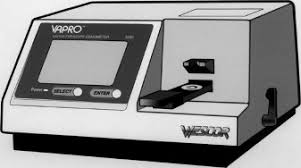
Unfortunately, osmometers are both big and expensive. They’re far too costly, complicated, and time-consuming for us to use on farms. The information is too sensitive for us as well. Why calculate the osmolality to the nearest 0.1 mOsm/kg when we can be plus or minus 5?
In practice, many scientists and medical professionals use equations to calculate osmolality. In human medicine, serum osmolality reflects overall body water balance and solute concentration, acting as a primary indicator for diagnosing severe imbalances like dehydration or poisoning, while urine osmolality reveals the kidney’s ability to concentrate or dilute urine, crucial for assessing water handling and diagnosing hormonal issues (like diabetes insipidus or SIADH) when compared against serum levels. Both are vital for understanding fluid and electrolyte disorders, with urine osmolality providing context to the serum value. While both may be measured accurately using an osmometer, they are often calculated using a formula of the most important osmolytes (the ions that contribute to osmolality).
In animal agriculture, as well, osmolality can be calculated. I realized that I didn’t really understand the methods used by different researchers in their various manuscripts, though there was a general agreement that, if we knew the concentration of the key osmolytes in milk (i.e., lactose and minerals) we could get a pretty good estimate of the solution’s osmolality. So, I set out to build a program to estimate osmolality, because I was too lazy to try to remember all of the osmolytes involved and their molecular weights.
The result is OsmoCalc. Enjoy!