Introduction
The NASCalf app follows a signficant line of growth prediction models in animal husbandry. Of course, the concept of growth is fundamental, so understanding both the biology and application of growth is essential to implementing nutrition programs to meet a farm’s goals for production and longevity. There are many growth models available in the literature, for both dairy (e.g., Souza et al. 2016 and below) and beef calves (e.g. Baldin et al., 2024). Continued research in both basic and applied areas of calf nutrition provide continued information from which to continue to improve these growth models and improve both accuracy and precision of prediction models.
The British statistician George Box wrote “All models are wrong, but some are useful” (https://en.wikipedia.org/wiki/All_models_are_wrong) which points to the well accepted fact that – at some point – any model will make assumptions about reality that don’t fit every situation. Though they may be wrong, calf growth models are inherently useful.
Nutrient Requirements vs. Calf Growth
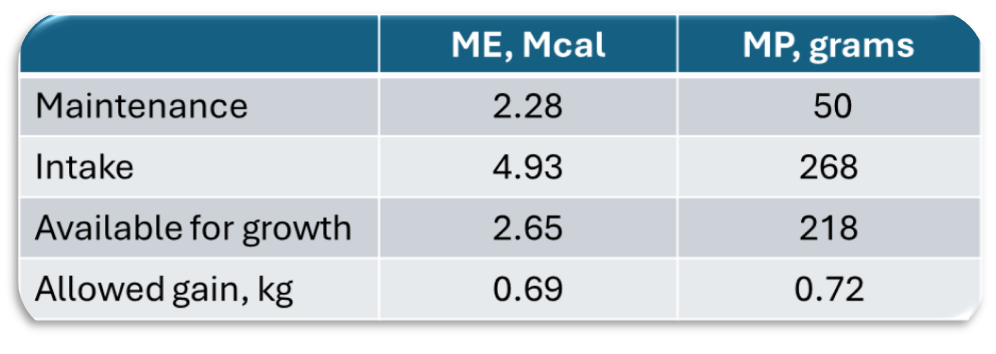
A basic tenet of animal nutrition is the idea that nutrients (particularly energy and protein) for productive functions such a growth, pregnancy, and growth are only available after needs for maintenance have been accomodated. The energy and protein “available for growth” (as in the table, right) dictate the productive ability of an animal. In the example, calves are fed sufficient metabolizable energy (ME) to gain 0.69 kilograms per day. The growth allowed by metabolizable protein (MP) intake is 0.72 kilograms per day.
Because calves don’t produce milk or use nutrients for gestation, the calculation of nutrients for growth is relatively straightforward. Of course, the use of nutrients for gain will depend on the age of the animal, degree of rumen development, types of feeds consumed, and numerous other factors. This is why a dynamic model of calf growth is so important.
The Need to Predict
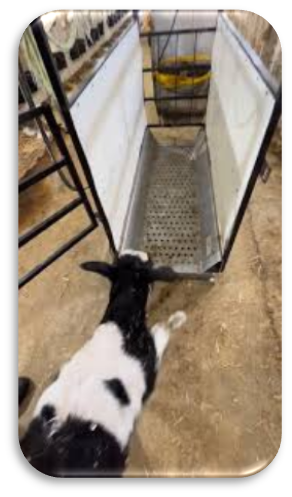
Unlike the picture to the right, weighing calves is not a common activity on most farms around the world. In my experience, however, more larger farms (>1,000 calves born per year) are routinely weighing calves at birth, weaning, about six months of age,at breeding, and calving to have a reasonable growth curve throughout the calf’s pre-calving life. However, in the majority of cases, calf growth – a critical factor involved with future milk production – is only determined by “eye-ball” estimates and an occasional measurement by weigh tape.
Early life growth can have profound effects on development of the mammary gland grows at a faster rate than the rest of the body from about two or three months of age to puberty (called “allometric growth”). Improper feeding during this time can permanently impair mammary development, thereby jeopardizing the animal’s future productivity in the herd. Thus, there is a compelling need to understand the impacts of the selected feeding program on animal growth.
Growth Models
A number of other entities have developed predictive models of calf growth based on nutrient requirements versus nutrient supply. Of course, the calf sub-model in the 2001 Nutrient Requirements of Dairy Cattle was a watershed moment in this regard. Prior nutrient calculations were limited in their scope, but the 2001 NRC calf sub-model attempted to predict growth on the basis of energy and protein supply versus requirements of calves under various conditions. Calculations were advanced for their time and predictions of growth were quite satisfactory. However, the calculations were based on “point-in-time” measurement – i.e., calculation of growth on one day of life. What was really needed was a method to predict growth throughout the early life of the calf.
As described by Larson (2022), a company in the United States (Milk Specialties Global (MSG), now named Actus Nutrition) developed a web-based prediction that predicted growth over an entire growing period. The model, like other predictive models, used the 2001 NRC sub-model to predict live body weight gain of a calf on the first day of life. This gain was added to birth body weight to calculate the animal’s body weight at the beginning of the second day. Intake of milk and dry feeds were estimated based on regression equations and nutrient supply was calculated. Body weight gain on day 2 was calculated as the nutrients available for growth after maintenance requirements were fulfilled and this gain was added to day-1 body weight. This process was repeated throughout the simulation period to calculate total growth, intake, cost, and feed efficiency.
The approach taken by MSG is similar to that of the CalfSim model from the Univerity of Vermont. CalfSim was developed by Drs. Tadeau Da Silva and Joao Costa and made available at https://tadeuedersilva.shinyapps.io/calfsim/. The Welcome screen is displayed in the figure below.
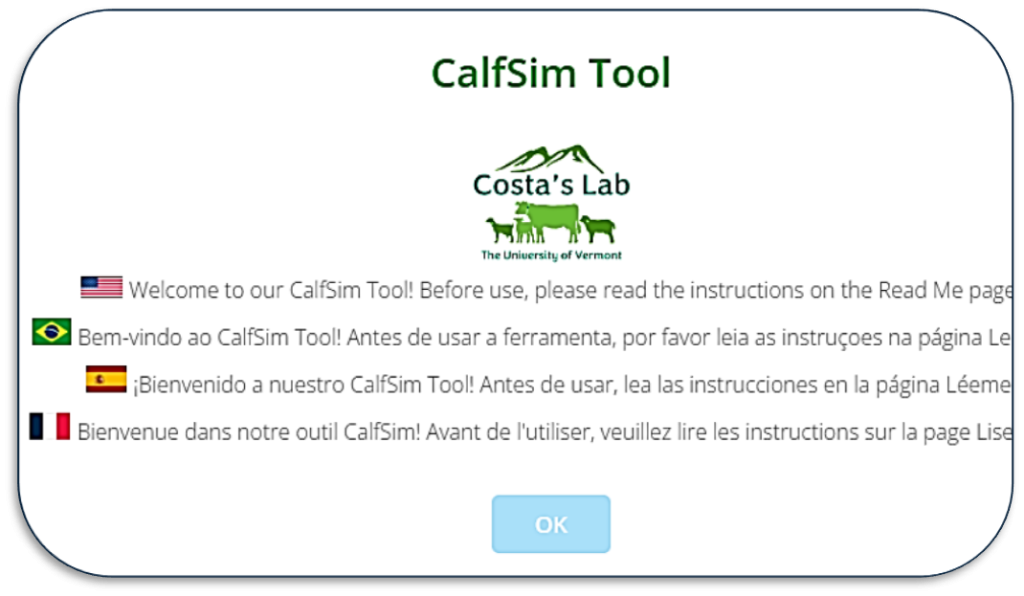
The CalfSim model follows logic similar to that of the MSG model, as does the NASCalf. CalfSim predicts growth through eight weeks of age whereas NASEM Tool predicts to 16 weeks.
Other programs available in the industry, including CNCPS (Cornell Net Protein and Carbohdyrate System) and AMTS (which implements many aspects of CNCPS into commercial software) follow a similar approach to that of CalfSim and NASCalf to various degrees.
With the publication of the 2021 Nutrient Requirements of Dairy Cattle, the NASEM Committee incorporated about 20 years of new information into an updated calf model. The new calf model was a remarkable improvement over the 2001 calf sub-model, though the “point-in-time” approach was maintained. Models like CalfSim and NASCalf followed the example of the MSG model to extend the point-in-time approach to a growth prediction model over a fixed period of time.
Summary
The need for predictive models like CalfSim and NASCalf have been recognized for many years and early attempts to make growth models available as well. Other commercial growth models developed by private companies are available also. These models can become the basis for further improvements in our ability to feed calves for optimal growth, production, and longevity.
References
- Baldin, G. C., C. Hildebrand, R. L. Larson, and P, A. Lancaster. 2024. Evaluation and development of a nutrition model to predict intake and growth of suckling calves. Ruminants. 4:47-78. https://doi.org/10.3390/ruminants4010004.
- Da Silva, T. E., and J.H.C. Costa. 2025. CalfSim tool: A free and user-friendly decision support tool for designing and simulating optimized feeding plans for dairy calves—A prediction assessment study. JDS Communications. 6:654–659. https://doi.org/10.3168/jdsc.2025-0777.
- Larson, R. 2022. Modeling Preweaning Dairy Calf Performance. Vet. Clin. Food Anim. 38:51–62. https://doi.org/10.1016/j.cvfa.2021.11.004.
- Souza, V. L., J. K. Drackley, R. Almeida, C.M.M. Bittar, T. Z. Albertini, S. Y. Morrison, and D.P.D. Lanna. 2016. Evaluation of nutrition models to estimate performance of young dairy calves: a meta-analytical study under tropical conditions. Animal. 10:1965-1974. https://doi.org/10.1017/S1751731116000975.