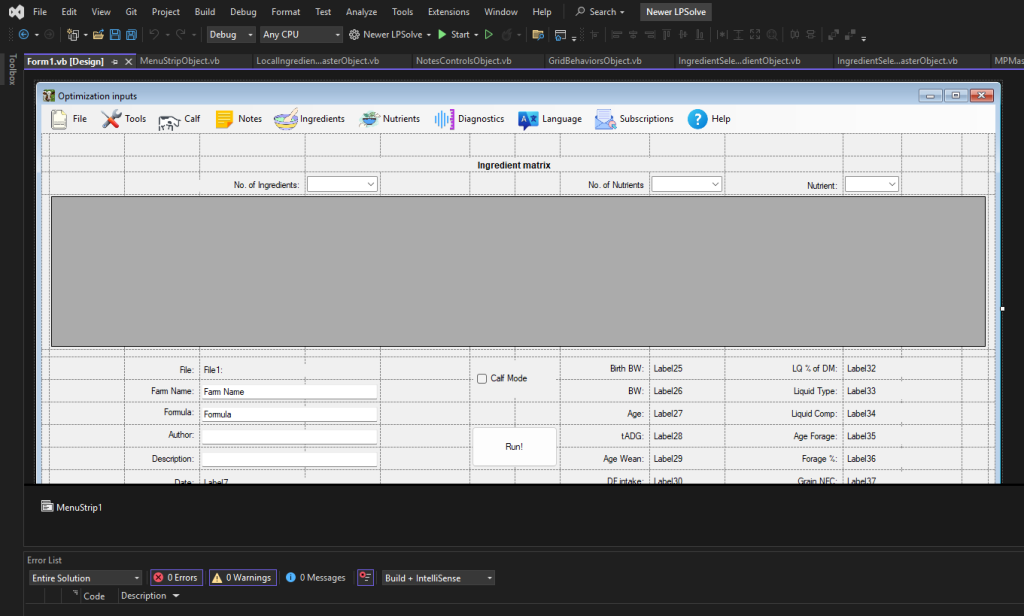
Building a modern desktop application with Visual Studio and Visual Basic .NET follows a well-established, professional workflow used by millions of developers worldwide. Visual Studio is Microsoft’s flagship development environment and is widely adopted in enterprise software, scientific tools, financial systems, and engineering applications. It provides a structured workspace for writing code, designing user interfaces, managing resources, and debugging complex logic. Applications such as LP-Solve–based ration formulators or tools like OsmoCalc benefit from this environment because it supports strong typing, robust error checking, and a clear separation between the user interface and the underlying calculation engine.
At the core of the process is writing source code in Visual Basic .NET, a high-level language designed to be readable, maintainable, and precise. Developers express logic using classes, functions, and objects that model real-world concepts—such as feeds, nutrients, or biological calculations—rather than low-level machine instructions. Visual Studio continuously analyzes this code as it is written, flagging syntax errors, type mismatches, and logical inconsistencies before the program is ever run. This early validation dramatically reduces errors and improves reliability, which is especially important in scientific or technical applications.
When the application is built, the Visual Basic source code is not compiled directly into machine-specific instructions. Instead, it is first converted into an Intermediate Language (IL), a standardized, platform-agnostic form of bytecode defined by the .NET framework. This intermediate step allows the same compiled program to run consistently across different Windows systems and hardware configurations. At runtime, the .NET Common Language Runtime (CLR) translates this IL into optimized native code for the user’s specific machine, handling memory management, security checks, and performance optimization automatically.

This layered compilation model—human-readable source code, intermediate language, and final machine execution—provides both flexibility and robustness. Developers can focus on correctness, clarity, and scientific accuracy, while the .NET runtime ensures efficient execution and system compatibility. For end users, the result is a fast, stable desktop application that behaves predictably and can be distributed easily through modern channels such as the Microsoft Store, without exposing or compromising the underlying intellectual property embedded in the source code.
Visual Basic also brings with it a long and proven history that contributes directly to the stability and reliability of modern Visual Basic .NET applications. First introduced in the early 1990s, Visual Basic quickly became one of the most widely used programming languages in the world due to its clarity, rapid development capabilities, and strong integration with the Windows operating system. Over time, it evolved from its original forms into Visual Basic .NET, fully aligned with the modern .NET ecosystem while preserving its core philosophy of readable, maintainable code. Today, Visual Basic remains in active use across industries such as finance, manufacturing, healthcare, engineering, and scientific research, supported by decades of real-world testing, mature tooling, and long-term backward compatibility. This history translates into dependable language behavior, a vast body of existing knowledge, and confidence that applications built today will remain maintainable and functional well into the future.